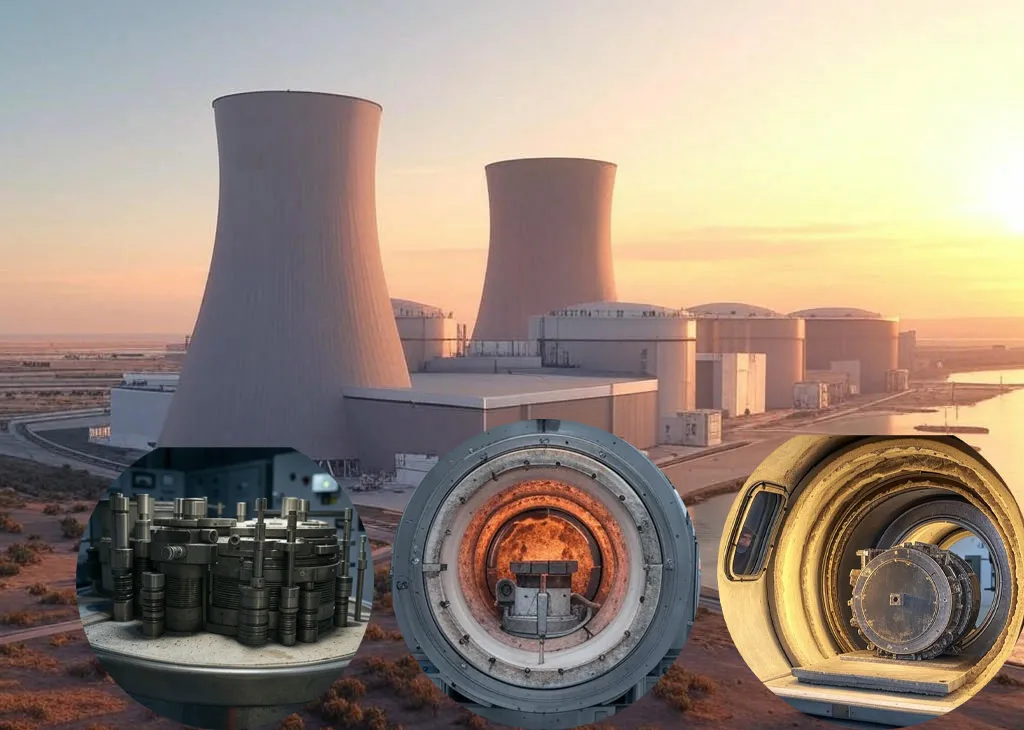
Ensuring Safety, Purity, and Long-Term Performance
1. Why the Nuclear Industry Demands Extreme Processing Standards
The nuclear industry is one of the most demanding sectors in terms of material integrity, purity, and reliability. Components used in nuclear reactors must withstand:
- Extreme temperatures
- Radiation exposure
- Corrosive environments
- Long operational cycles
Even microscopic defects or contamination can lead to serious safety risks or system failures.
👉 This is why vacuum furnace technology has become essential in nuclear material processing.
2. Key Challenges in Nuclear Material Processing
Manufacturers in the nuclear field typically face several critical challenges:
- ❌ Oxidation and contamination during heat treatment
- ❌ Gas absorption (hydrogen, nitrogen) affecting material properties
- ❌ Poor bonding quality in brazing or welding
- ❌ Inconsistent microstructure and density
- ❌ Strict regulatory compliance requirements
👉 Traditional atmosphere furnaces often cannot meet these standards.
3. How Vacuum Furnaces Solve These Problems
Vacuum furnaces provide a clean, controlled, and oxygen-free environment, which is crucial for nuclear-grade materials.
✔ Core Advantages:
- No oxidation or nitridation
- Ultra-high purity processing
- Precise temperature control
- Uniform heating
- Repeatable and traceable processes
👉 This ensures defect-free components and stable material performance.
4. Typical Applications in the Nuclear Industry
🔹 4.1 Heat Treatment of Nuclear Materials
Processes include:
- Annealing
- Stress relieving
- Hardening
👉 Improves:
- Mechanical strength
- Structural stability
- Resistance to radiation damage
🔹 4.2 Sintering of Nuclear Fuel Materials
Vacuum sintering is widely used in:
- Uranium-based fuel pellets
- Advanced ceramic nuclear materials
👉 Benefits:
- High density
- No contamination
- Controlled microstructure
🔹 4.3 Brazing and Diffusion Bonding of Critical Components
Used for:
- Heat exchangers
- Control rods
- Reactor internal structures
👉 Vacuum environment ensures:
- Oxidation-free joints
- High bonding strength
- Long-term reliability
🔹 4.4 Degassing and Decontamination
Vacuum annealing helps remove:
- Hydrogen
- Residual gases
👉 Prevents:
- Embrittlement
- Corrosion
- Structural failure
🔹 4.5 R&D and Advanced Material Development
Vacuum furnaces are essential for:
- Testing new alloys
- Simulating nuclear environments
- Developing high-performance materials
5. Haoyue Vacuum Furnace Solutions for the Nuclear Industry
Based on different processes, Haoyue provides targeted furnace solutions:
🔹 G Series – Gas Pressure Sintering Furnace
Best for:
- Nuclear fuel materials
- High-density sintering
Solves:
- Porosity issues
- Low density
- Structural inconsistency
👉 Delivers:
- High densification
- Uniform microstructure
🔹 H Series – Vacuum Hydrogen Furnace
Best for:
- High-purity metal processing
- Oxide-sensitive materials
Solves:
- Oxidation
- Impurity contamination
👉 Ideal for:
- Zirconium alloys
- Special nuclear metals
🔹 D Series – Vacuum Diffusion Bonding Furnace
Best for:
- Critical component joining
- Multi-layer structures
Solves:
- Weak joints
- Welding defects
👉 Ensures:
- High-strength, defect-free bonding
🔹 C Series – CVD/CVI Furnace
Best for:
- Protective coatings
- Advanced nuclear materials
👉 Enables:
- Corrosion resistance
- Radiation resistance enhancement
6. Typical Nuclear Components Produced
Using vacuum furnace technology, manufacturers can produce:
- Nuclear fuel pellets
- Control rod components
- Heat exchanger parts
- Reactor structural components
- High-performance alloys
- Advanced ceramic components
7. Why Choose Haoyue for Nuclear Applications
- ✔ High vacuum level & atmosphere control
- ✔ Precise temperature uniformity
- ✔ Proven experience in high-end materials
- ✔ Custom solutions for complex processes
- ✔ Stable performance for long production cycles
👉 Designed to meet strict nuclear industry standards
8. Conclusion: A Critical Technology for Nuclear Safety
Vacuum furnaces are not just equipment—they are a cornerstone of nuclear safety and performance.
They ensure:
- Material purity
- Structural integrity
- Long service life
- Compliance with strict regulations