Enabling High-Performance Materials and Precision Manufacturing
1. Why Aerospace Demands Extreme Processing Standards
The aerospace industry operates under some of the most demanding conditions in engineering. Components must withstand:
- Extreme temperatures
- High mechanical stress
- Pressure fluctuations
- Long service cycles
Even the smallest defect can lead to critical failure or safety risks.
👉 This is why vacuum furnace technology is essential for aerospace manufacturing.
2. Key Challenges in Aerospace Material Processing
Manufacturers face several critical challenges:
- Oxidation during heat treatment
- Decarburization and surface contamination
- Internal porosity and gas entrapment
- Weak or inconsistent joints
- Strict regulatory and quality requirements
👉 Conventional furnaces cannot provide the level of control required for aerospace-grade materials.
3. How Vacuum Furnaces Improve Aerospace Manufacturing
Vacuum furnaces provide a clean, oxygen-free, and precisely controlled environment, enabling superior material performance.
Core Advantages:
- No oxidation or contamination
- Precise temperature control and uniform heating
- Controlled atmosphere for advanced processes
- Effective degassing capability
- High repeatability and process stability
👉 These advantages are critical for ensuring reliability and performance in aerospace components.
4. Key Applications in the Aerospace Industry
4.1 Heat Treatment of Aerospace Alloys
Processes include:
- Annealing
- Stress relieving
- Hardening
Benefits:
- Improved ductility and toughness
- Enhanced fatigue resistance
- Reduced internal stress
Used for:
- Turbine blades
- Structural components
- Engine parts
4.2 Vacuum Brazing of Precision Components
Applications:
- Heat exchangers
- Fuel system components
- Honeycomb structures
Benefits:
- Oxidation-free joints
- High bonding strength
- Excellent dimensional accuracy
4.3 Vacuum Sintering of High-Performance Parts
Used for:
- Powder metallurgy components
- Engine and structural parts
Advantages:
- High density
- Low porosity
- Superior mechanical strength
4.4 Degassing of Aerospace Materials
Vacuum furnaces remove:
- Hydrogen
- Trapped gases
Results:
- Reduced porosity
- Improved material consistency
- Enhanced mechanical performance
4.5 Advanced Coating Processes (CVD/CVI)
Used for:
- Thermal barrier coatings
- Wear-resistant coatings
- Corrosion protection
Benefits:
- Improved heat resistance
- Extended component life
- Enhanced performance in extreme environments
5. Haoyue Vacuum Furnace Solutions for Aerospace Applications
G Series – Gas Pressure Sintering Furnace
Best for:
- High-performance powder metallurgy parts
Solves:
- Porosity and density issues
- Structural inconsistency
Result:
- High-strength, dense components
H Series – Vacuum Hydrogen Furnace
Best for:
- High-purity alloy processing
- Oxide-sensitive materials
Solves:
- Oxidation and contamination
Applications:
- Nickel-based superalloys
- Titanium alloys
D Series – Vacuum Diffusion Bonding Furnace
Best for:
- Complex aerospace structures
- Multi-layer assemblies
Solves:
- Weak joints
- Welding defects
Result:
- High-strength, reliable bonding
C Series – CVD/CVI Furnace
Best for:
- Advanced coatings and surface engineering
Enables:
- Thermal barrier coatings
- Wear and corrosion resistance
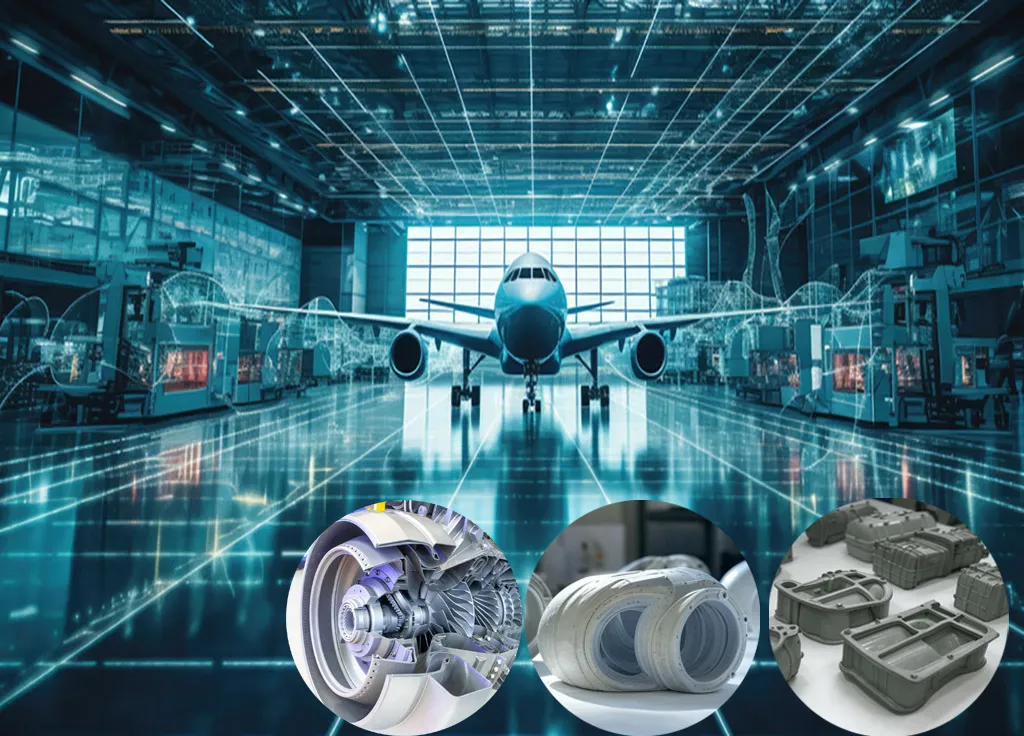
6. Typical Aerospace Components Produced
Vacuum furnace technology enables the production of:
- Turbine blades
- Heat exchangers
- Fuel system components
- Structural aerospace parts
- Superalloy components
- Coated high-temperature parts
7. Why Choose Haoyue
- Advanced vacuum and atmosphere control
- Excellent temperature uniformity
- Stable and repeatable processing
- Custom-engineered solutions
- Proven capability in high-end material applications
👉 Helping aerospace manufacturers achieve higher performance, reliability, and compliance
8. Conclusion
Vacuum furnaces are a critical technology in aerospace manufacturing, enabling:
- Superior material properties
- High precision and consistency
- Long component lifespan
- Compliance with strict industry standards
They are essential for both current production and future material innovation.
Call to Action
If you are working in aerospace manufacturing:
👉 Tell us your material, process, and application
👉 We will recommend the most suitable vacuum furnace solution