Application context
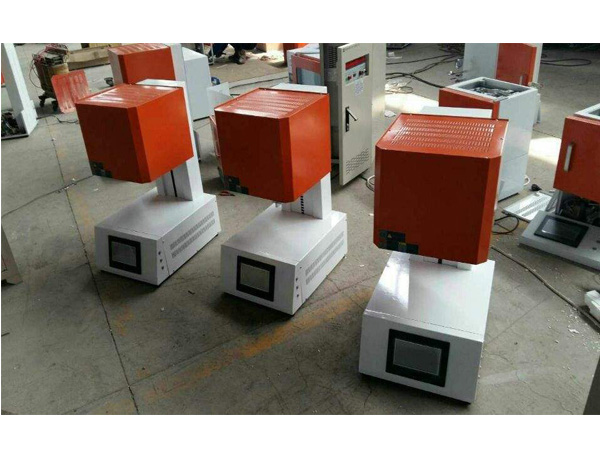
Delicate ceramics, setters and stacked trays benefit from a loading position that is easy to reach. A lift-furnace layout creates access below the heating body and organises movement along a vertical axis. The workshop photograph shows several units built around this arrangement.
The process challenge
Make loading easier without disturbing the samples
A carefully arranged ceramic batch can be difficult to transfer through a narrow chamber opening. Setters, crucibles and stacked trays need stable support and sufficient clearance to preserve their position during loading.
Vertical loading changes that geometry. The support, travel and hot zone must be matched to the full fixture stack, including clearance at the top and sides. For zirconia and other technical ceramics, the program must also follow the specific material and fixture system: a shorter cycle is useful only when the finished properties remain acceptable.
- Consider the complete fixture stack as well as each individual part.
- Provide access without reaching deep into a chamber.
- Review alignment and stability throughout the vertical movement.
- Select the thermal profile around the material's requirements.
The equipment solution
A vertical heating assembly above an accessible base
The photograph shows several similar units with elevated heating enclosures supported above separate lower bases. Each base carries its own front-facing control screen.
The open space below the heating body illustrates the access offered by this architecture. For a similar HuanYu configuration, the moving assembly, loading height and fixture support would be specified together. The working zone and thermal profile would then be matched to the loaded arrangement.
- 01Vertical architecture places the heating body above the loading position.
- 02Separate lower base provides an operating interface for each unit.
- 03Access around the loading area assists fixture positioning.
Equipment details
- Multiple similar vertical furnace units in a workshop
- Heating enclosures above lower bases
- Vertical support structure behind each heating body
- Individual control screens on the front of the bases
Practical value
How the design supports the process
| Process priority | Equipment design | Practical purpose |
|---|---|---|
| Loading access | Space below the heating body | Access around the loading position for placing fixtures and samples. |
| Fixture arrangement | Vertical loading geometry | The layout can be specified around the complete support stack. |
| Operating position | Screen on each lower base | An individual operating interface beside each loading position. |
This configuration centres on access to the load. Matching vertical travel, support geometry and the hot zone to the actual fixture stack is the essential step for a comparable ceramic-processing requirement.
For your project
Planning a similar installation
For a comparable requirement, the following checks help connect the equipment specification to the process you need to run.
- 01
Review fixture-stack dimensions, load mass and loading height.
- 02
Check travel alignment and clearance through the complete movement.
- 03
Agree the movement limits and protection for the selected lift mechanism.
- 04
Verify the thermal profile with the intended fixtures and samples.
Talk to HuanYu
Tell us about your application
- Material and firing profile
- Fixture-stack dimensions and loaded mass
- Loading height and movement arrangement
- Working-zone and sample-quality criteria